

Just gathering information? We’re happy to help you understand safe exercise options with no pressure or obligation.
Best Exercise for Dogs With Arthritis
Helping Arthritic Dogs Stay Strong Without Overdoing It
One of the most common questions owners ask after an arthritis diagnosis is:
“Should my dog still be exercising?”
The answer is usually yes — but the type of exercise matters enormously.
For dogs with arthritis, movement is often one of the most important parts of maintaining mobility and comfort. However, too much exercise, the wrong type of activity, or inconsistent routines can also worsen soreness and inflammation.
The goal is not intense exercise. It is controlled, sustainable movement that helps maintain:
-
Muscle strength
-
Joint support
-
Flexibility
-
Balance
-
Confidence
-
Overall quality of life
Many dogs with arthritis actually become stiffer and weaker when activity drops too much.
The challenge is finding the right balance.
Why Exercise Matters for Dogs With Arthritis
When arthritic dogs move less, several things often happen:
-
Muscles weaken
-
Joints become less supported
-
Weight gain occurs more easily
-
Stiffness increases
-
Balance worsens
-
Mobility declines faster
This creates a cycle where reduced movement leads to worsening function.
Appropriate exercise helps interrupt that cycle.
Movement helps:
-
Maintain muscle strength
-
Lubricate joints
-
Improve circulation
-
Reduce stiffness
-
Improve coordination
-
Support healthy weight management
Importantly, “appropriate exercise” is different for every dog.
A senior Labrador with hip arthritis requires a very different program from a small dog with spinal arthritis or a young dog with elbow dysplasia.


The Best Type of Exercise for Arthritic Dogs
Controlled Walking
For many dogs, walking is the best foundation exercise.
Walking helps maintain:
-
Muscle strength
-
Joint mobility
-
Cardiovascular fitness
-
Mental stimulation
However, consistency is usually more important than intensity.
Short, regular walks are generally better than:
-
Long exhausting walks
-
Weekend “catch-up” exercise
-
High-impact activity followed by days of rest
Many arthritic dogs cope best with:
-
Flat surfaces
-
Predictable terrain
-
Moderate pace
-
Frequent shorter sessions
Learn more about Should You Walk a Dog With Arthritis?
Strengthening Exercises
Targeted strengthening exercises help support unstable or painful joints.
Depending on the dog, exercises may include:
-
Sit-to-stand repetitions
-
Controlled incline walking
-
Weight shifting
-
Cavaletti poles
-
Balance exercises
-
Core strengthening
These exercises are usually introduced gradually and adjusted carefully depending on soreness levels and fatigue.
The goal is improving stability — not exhausting the dog.


Hydrotherapy
Hydrotherapy is often one of the most effective exercise options for arthritic dogs.
Water buoyancy reduces joint loading while still allowing muscle strengthening and cardiovascular exercise.
Hydrotherapy may help dogs who:
-
Struggle with land exercise
-
Have significant arthritis pain
-
Are overweight
-
Have muscle loss
-
Are recovering after surgery
Many dogs move more comfortably in water than on land.
No commitment needed — we’re happy to discuss whether rehabilitation exercises may suit your dog.
Exercises That Are Often Difficult for Arthritic Dogs
Not all exercise is beneficial.
Some activities place excessive stress on painful joints, especially when arthritis is advanced.
Activities that may worsen soreness include:
-
Repetitive ball chasing
-
Sudden twisting movements
-
High jumping
-
Slippery running surfaces
-
Intense weekend exercise
-
Long runs on hard ground
-
Repeated stair climbing
This does not mean dogs can never enjoy these activities again, but they may need modification or reduced intensity.

Is Swimming Good for Dogs With Arthritis?
Swimming can be excellent for some dogs, but not all.
Benefits may include:
Reduced joint impact
Improved cardiovascular fitness
Muscle strengthening
However, swimming also requires significant effort and may aggravate some shoulder, neck, or spinal conditions if poorly controlled.
Not every arthritic dog is naturally suited to swimming.
Structured hydrotherapy is often safer and more controlled than uncontrolled swimming sessions.

How Much Exercise Does an Arthritic Dog Need?
There is no universal rule.
Exercise tolerance depends on:
-
Arthritis severity
-
Joint location
-
Muscle strength
-
Fitness level
-
Body weight
-
Age
-
Pain levels
-
Other medical conditions
As a general principle:
-
Regular moderate exercise is usually better than sporadic intense exercise.
-
Mild fatigue is acceptable.
-
Significant worsening soreness afterward usually means the exercise level was too high.
A rehabilitation plan helps determine the right balance for the individual dog.

.png)
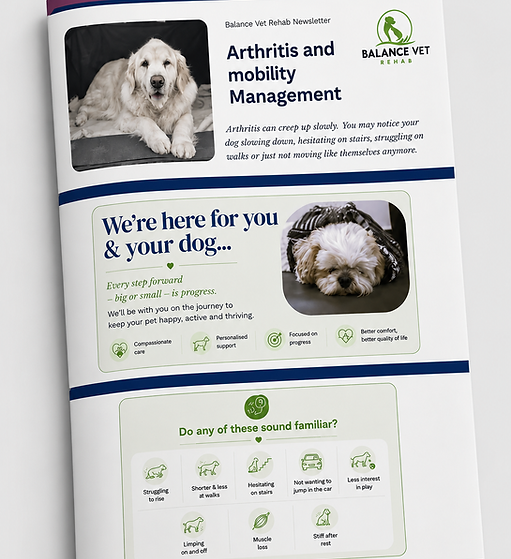
Want a clear arthritis guide you can read later?
If you’re still gathering information, you may find it helpful to read through our arthritis guide in your own time.
It covers:
• what arthritis means
• common signs to look for
• treatment and management options
• how to keep your dog comfortable and active
• what long-term care may involve
👉 Download the Arthritis Guide

Signs Your Dog May Be Overdoing Exercise
Owners are often surprised that over-exercising can worsen arthritis symptoms.
Signs may include:
-
Increased stiffness afterward
-
Limping later in the day
-
Slower rising the next morning
-
Reluctance to move
-
Excessive fatigue
-
Behavioural changes
-
Increased soreness after activity
-
Sometimes symptoms do not appear until hours later or the following day.
Monitoring recovery after exercise is often more useful than assessing performance during activity itself.
Weight Management & Exercise Work Together
Exercise alone cannot fully compensate for excess body weight.
Even modest weight reduction can significantly reduce stress on arthritic joints.
For many dogs, combining:
-
Controlled exercise
-
Muscle strengthening
-
Weight management
…provides the best long-term improvement in mobility and comfort.


What About Senior Dogs?
Older dogs still benefit enormously from movement.
In fact, complete rest often accelerates weakness and mobility decline.
Senior dogs commonly benefit from:
-
Gentle strengthening
-
Controlled walking
-
Balance exercises
-
Hydrotherapy
-
Environmental support
Learn more about Is My Dog Slowing Down From Age or Arthritis?
Exercises Often Used in Veterinary Rehabilitation
Veterinary rehabilitation programs may include:
-
Sit-to-stand exercises
-
Controlled leash walking
-
Backing up exercises
-
Figure-eight walking
-
Balance equipment
-
Core strengthening
-
Proprioception training
-
Incline work
-
Hydrotherapy
Exercises are tailored carefully based on the dog’s:
-
Condition
-
Pain levels
-
Confidence
-
Strength
-
Mobility goals

Still deciding whether rehab is appropriate? We’re happy to answer questions and discuss your dog’s situation.

Arthritis Often Involves More Than One Joint
Many arthritic dogs compensate heavily through other areas of the body.
For example:
-
Hip arthritis may overload the knees
-
Elbow arthritis may strain the shoulders
-
Spinal arthritis may affect hind limb coordination
This is why rehabilitation focuses on the entire dog rather than a single painful joint.
Learn more about:
-
Hip Dysplasia in Dogs
-
Elbow Dysplasia in Dogs
-
Cruciate Ligament Injuries in Dogs
-
Patella Luxation in Dogs
Supporting Dogs Across Brisbane, Gold Coast & Scenic Rim
We help dogs across Brisbane, Gold Coast, and Scenic Rim experiencing:
-
Arthritis
-
Mobility decline
-
Weakness
-
Post-surgical stiffness
-
Chronic orthopaedic pain
-
Reduced exercise tolerance
Every rehabilitation plan is individualised based on the dog’s condition, lifestyle, and mobility goals.

Hear From Families Supporting Arthritic Dogs
Many owners worry that exercise may worsen arthritis.
Often, the opposite is true when movement is introduced appropriately and consistently.

Movement Is Often Part of the Solution — Not the Problem
Many arthritic dogs become more comfortable when they maintain appropriate movement and muscle support.
The key is:
-
Controlled exercise
-
Consistency
-
Joint-friendly activity
-
Individual tailoring
Finding the right balance can make a significant difference to comfort, mobility, and quality of life.
Helping Dogs Stay Active & Comfortable
Arthritis does not necessarily mean dogs must stop enjoying movement.
With the right exercise approach, many dogs continue enjoying:
-
Walks
-
Adventures
-
Social interaction
-
Family activities
-
Comfortable daily movement
The goal is not pushing through pain. It is helping dogs move safely and confidently for as long as possible.

Want Guidance on Safe Exercise for Your Dog?
Whether your dog has recently been diagnosed with arthritis or has been slowing down for some time, we’re happy to help you explore safe rehabilitation and exercise options.
No pressure — we’re happy to help you understand what may be appropriate for your dog first.